
MUSIC · MEMORY · SOCIAL CHANGE
The Mirror of Conscience:
Music and Social Change Radio
Songs remember what nations try to forget. The Mirror of Conscience carries the warnings of artists, movements, and historic events into the moral choices confronting us now.
Artist portraits. Cultural history. Time Capsules. Original songs of conscience.
Segment banner song: The Answer is Us
What the show is
The Mirror of Conscience is music and social change radio for people who hear an old song and recognize that its warning never ended. It explores how artists, social movements, and historic events turn fear, grief, resistance, and hope into public memory, then asks what that memory requires of us now.
This is not a 1960s nostalgia hour.
Vietnam era protest songs are one doorway into the program because the antiwar movement produced some of the most enduring songs of conscience in American music. But The Mirror of Conscience follows a much larger tradition: civil rights, Stonewall, labor, repression, surveillance, war, identity, democracy, and the moments when music gave people language for what power wanted hidden.
Each episode begins with a song, artist, album, event, or remembered scene.
What was happening around it? What were people trying to tell us? What did the country hear? What did it refuse to hear? What happened when the warning was ignored?
The program treats protest music history not as a museum display, but as evidence. It is a record of what people feared, loved, resisted, and hoped to build. The music of social movements reveals how private conscience became public language and how strangers found the courage to recognize one another.
Time Capsules carry that method forward. A story may begin at Stonewall, Altamont, an antiwar march, a courtroom, a recording studio, or a moment almost lost to public memory. It then maps the lesson into today’s political landscape. The uniforms may change. The policies, databases, and institutions may be new. But the central questions remain:
Who is being marked? Who is being silenced? What does power call order? What does conscience require?
The program also creates original Barking Justice Music from these encounters with history.
The Garden and the Shore places the dream of collective transformation beside the devastation left when that dream fails. Its underlying analysis creates a conversation between the hope represented by “Woodstock” and the aftermath imagined in “Wooden Ships,” then places the moral choice in the hands of the present-day listener. The resulting anthem moves between the pilgrim walking toward the garden and the survivor emerging from the shore until both become part of one continuing human story.
The Water Keeps Our Name draws from a warm American roots lineage to ask how cruelty, mercy, silence, and courage continue moving long after the original moment has passed. Its central argument is that every action leaves something in the current for those who come after us.
This is where music and activism become more than subject matter. They become a way to see the present.
Through narrated cultural history, artist portraits, Time Capsules, and original anthems, The Mirror of Conscience listens backward so that listeners can choose forward.
It does not ask whether the old songs still sound beautiful.
It asks whether we finally understand what they were trying to tell us.

Show details
Who it’s for
When it airs
Tuesday 6 PM · Thursday 10 PM · Friday 10 PM · Sunday 8 PM, streaming live at BJR.FM
Format
Signature
Representative anthems
Music carries the argument as much as the narration does. These are the tracks that make up The Mirror of Conscience’s rotation:
All tracks are original productions from Barking Justice Music, produced for Barking Justice Radio.
Merch preview
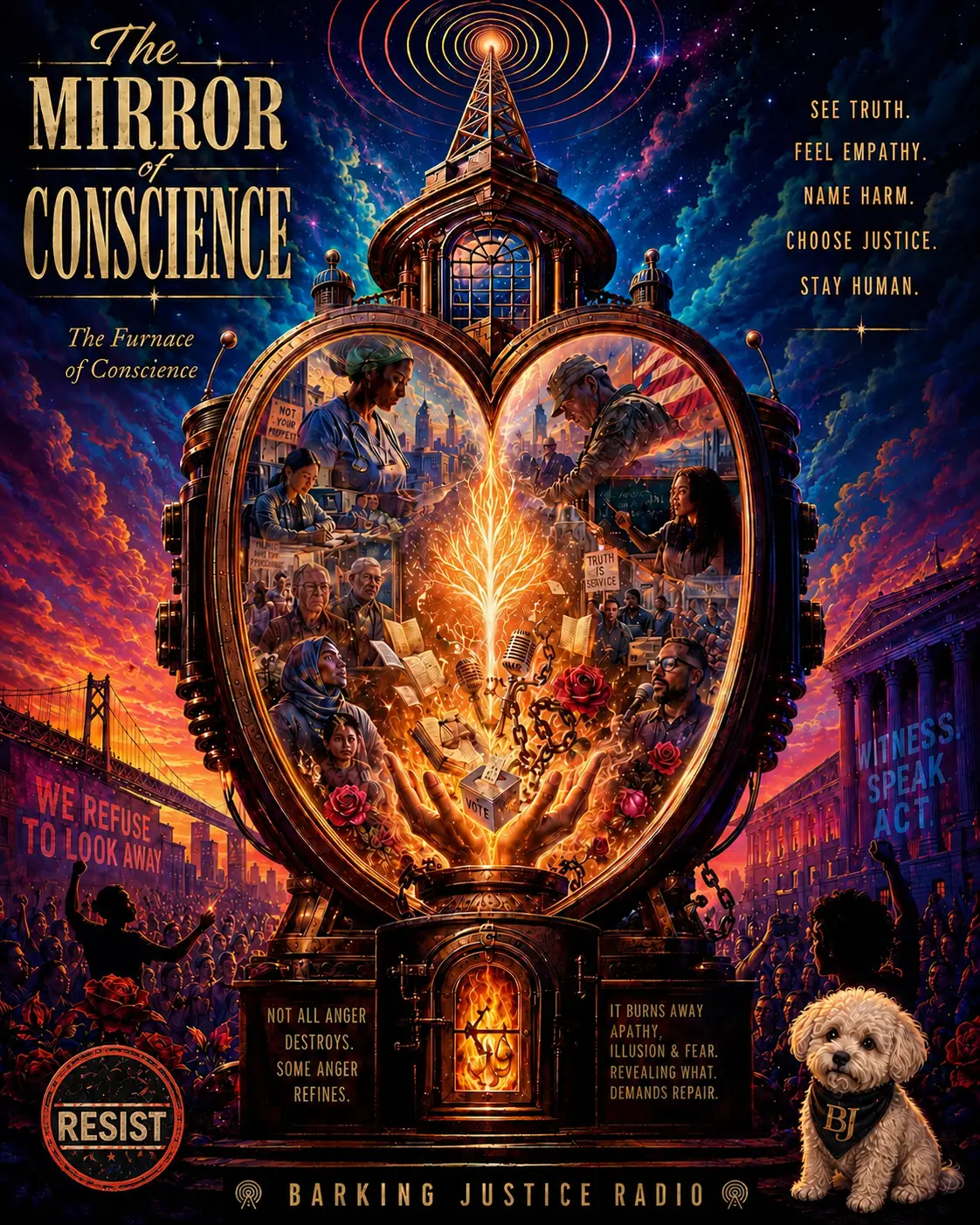
Merch Preview
The Mirror of Conscience
Artwork — soon available on our Merch page.
Related excerpt
From the segment banner song: The Answer is Us
This anthem opens the segment at the same moral crossroads Bob Dylan once put to the country: simple questions so deep they make the whole nation squirm. It refuses to let the listener hide the answer inside a committee, a foundation, or a slogan.
“How many lies must the truth stumble through, before we believe again? The answer, my friend, still echoes from the past.”
Read the full lyrics and civic context in The Firing Line’s companion piece on protest music and national memory.
Frequently asked questions
What is The Mirror of Conscience on Barking Justice Radio?
The Mirror of Conscience is a 60-minute music and social change radio program exploring how artists, songs, social movements, and historic events carry moral and political lessons into the present.
Through cultural history, artist portraits, Time Capsules, and original Barking Justice Music, it connects public memory to the choices confronting citizens today.
Is The Mirror of Conscience only about 1960s protest music?
No. Vietnam era protest songs, civil rights music, and the movements of the 1960s and 1970s are important foundations, but they do not define the program’s limits.
Episodes may explore Stonewall, labor, war, repression, surveillance, democracy, identity, public memory, contemporary activism, or any moment when music helped people recognize injustice and respond to it.
What are Mirror of Conscience Time Capsules?
Time Capsules are narrated audio stories that begin with a person, event, song, place, or memory and follow its unfinished lesson into the present.
A Time Capsule does more than recount what happened. It asks what the event revealed about power, fear, solidarity, repression, or moral courage, and how the same pattern may be appearing in a different form today.
How does the program connect music to social change?
The program examines how songs give movements shared language, preserve experiences that institutions may ignore, and help people turn private emotion into public understanding.
The Mirror of Conscience considers both the music of social movements and the social conditions that created it. It then asks what those songs of conscience still require from listeners today.
Does The Mirror of Conscience play covers of historic protest songs?
No. The program draws inspiration from the moral, cultural, and musical lineages of historic artists, but the featured Barking Justice Music anthems are original works, not covers or replicas.
Some songs begin with an analysis of an earlier work or musical tradition and then create a new story for the present moment.
What should listeners expect from an episode?
Listeners can expect narrated cultural history, musical interpretation, artist portraits, historic events, original protest music, and moments of moral reflection.
Some episodes center on one artist or album. Others use a Time Capsule to connect an event such as Stonewall or Altamont with a current system, policy, or civic danger.
Why is protest music history still relevant?
Protest music history records what people understood while events were still unfolding. The songs preserve warnings, fears, hopes, and demands that official histories often soften after the fact.
Listening again helps us recognize which struggles changed, which merely changed form, and which promises remain unfinished.
