
ORIGINAL FREEDOM SONGS · LIVING CIVIL RIGHTS HISTORy
Civil Rights Music and History:
The Civil Rights Memory Hour
A 90-minute civil rights radio program pairing original freedom songs with Black history through music, voting-rights memory, movement testimony, and the unfinished fight for equal citizenship.
Original music. Narrated history. Memory with a pulse. Barking Justice Radio streams 24/7.
Segment banner song: The Dream Still Marches
What you will hear
Civil rights music and history belong together because the movement did not only speak. It sang, organized, marched, prayed, mourned, and kept the record. The Civil Rights Memory Hour carries that record from slavery and Reconstruction through Jim Crow, school desegregation, labor struggle, voting rights, and the unfinished fight for equal citizenship today.
Through original freedom songs, narrated history, and moral testimony, the program presents civil rights history through music and carries its lessons into the choices confronting American democracy now. These stories return wherever voting rights are narrowed, books are removed, protest is treated as danger, or equal citizenship is made conditional.

Show details
Who it’s for
Civic listeners, educators, students, families, history audiences, and anyone who wants to understand how movement memory helps us read the present.
When it airs
Monday 2 PM · Wednesday 2 PM · Friday 2 PM · Saturday 2 PM · Sunday 6 AM, streaming live.
Format
90 minutes. Narrated civil rights history and moral testimony paired with original freedom songs and protest music.
The promise of the program
Freedom was never handed down — it was demanded, defended, sung, and marched for.
Why Civil Rights Memory Still Matters
The hour does not let history stay comfortable. It asks why a six-year-old had to integrate a schoolhouse before the law was ready to protect her, and names that as a failure of adults, not just a triumph of children. It pulls Ella Baker, Septima Clark, Diane Nash, Jo Ann Robinson, Fannie Lou Hamer, and the women who built the movement’s infrastructure out of the footnotes and back into the center of the story, alongside the leaders history put on the podium. And it refuses to let the movement’s heroes be flattened into safe quotations, insisting instead on the demand underneath the dream.
Running through the hour is a single organizing idea: managed forgetting. Not a bonfire of records, but a slower erasure built from underfunding, insufficient urgency, and archives left to lose their lease, until a gap in the record gets mistaken for the end of the story. The segment treats that as a civic hazard in its own right, because a country that stops teaching who built redlining, who fought it, and who paid for it loses the ability to recognize the same architecture when it returns wearing a different name.
Memory becomes civic protection when it helps people recognize that an old system has returned through new language, new procedure, or a new institution.
Every episode brings that history forward through original protest music, remembrance, and moral testimony, showing how earlier struggles shape today’s battles. Freedom was never handed down. It was demanded, defended, sung, and marched for, and this segment treats that demand as unfinished business rather than a closed chapter. The hour listens back so listeners can look forward, asking who gets protected, who gets believed, who gets counted, and who gets to breathe freely inside the promise of America.
Original Freedom Songs That Keep Civil Rights History Alive
Music carries the argument alongside the narration. The Civil Rights Memory Hour features original civil rights music, freedom songs, voting rights songs, and black history songs that carry movement memory into the present.
These are not recreations of historical recordings or nostalgia pieces. They are new anthems written from the record of the movement, preserving its moral lessons and asking what those lessons require from citizens now.
All tracks are original productions from Barking Justice Music, produced for Barking Justice Radio.
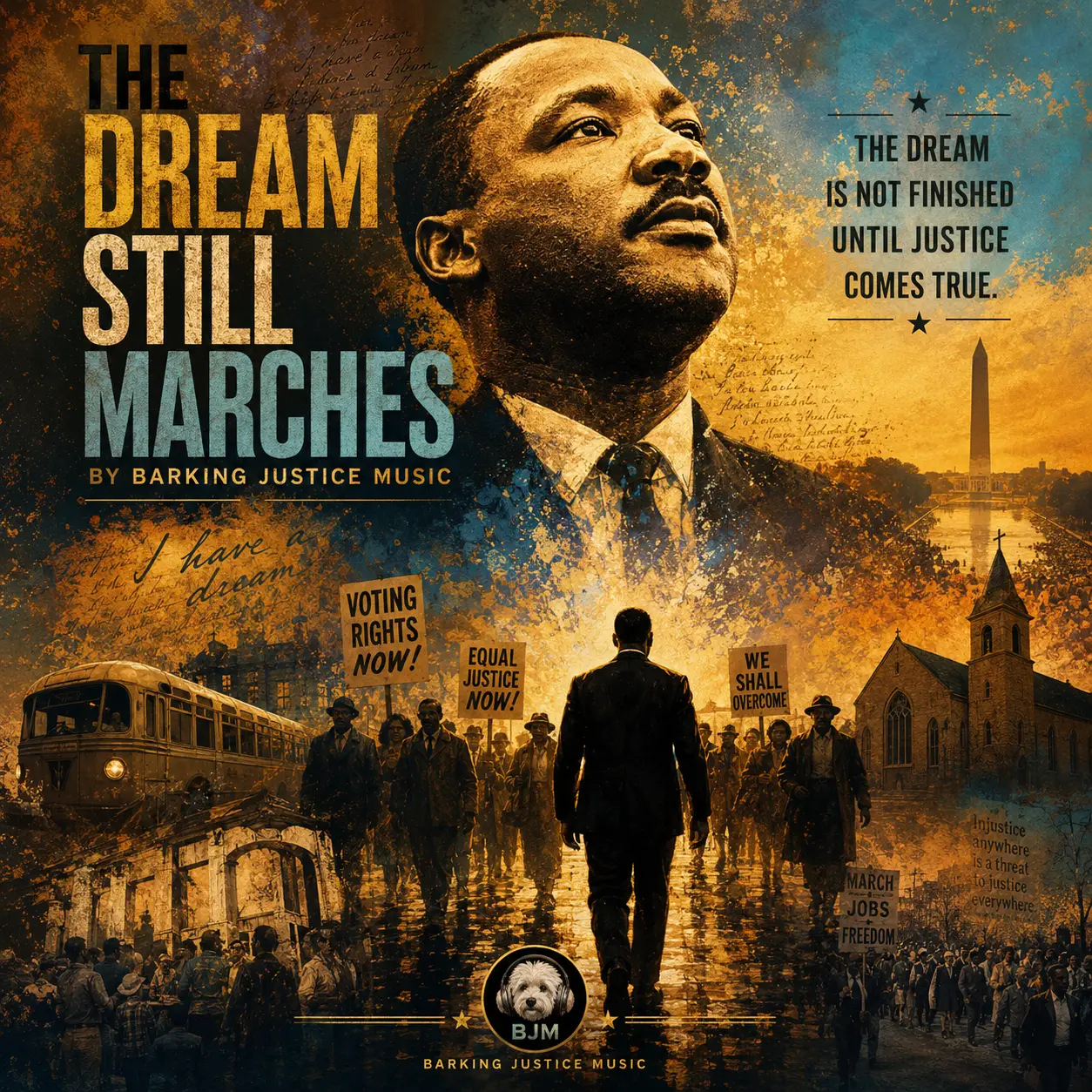
The Dream Still Marches: Civil Rights Anthem Artwork
Merchandise
The Dream Still Marches
Join The Monthly Signal for new civil rights music, program updates, and notice when The Dream Still Marches artwork becomes available. ⤷ CONNECT
Related excerpt
From the segment banner song: The Dream Still Marches
This anthem opens the segment by remembering Dr. Martin Luther King Jr. not as a statue or a holiday, but as a witness, a preacher, and a strategist who understood that love without justice becomes silence. It treats the dream as a demand still awaiting an answer.
“The dream still marches. It walks through the flame. It carries the wounded. It calls every name.”
Frequently asked questions
What is The Civil Rights Memory Hour?
The Civil Rights Memory Hour is a 90-minute civil rights radio program exploring civil rights movement history through original freedom songs, narrated history, remembrance, and moral testimony.
What is "managed forgetting," and why does the segment keep coming back to it?
Managed forgetting is the segment’s term for how civil rights history gets erased quietly rather than dramatically — through underfunded archives, cut curricula, and witnesses the country never gets around to recording before it’s too late. The show treats that erosion as a present-day civic risk, not a historical footnote, because a gap in the record is easy to mistake for proof that something didn’t happen or doesn’t matter.
Why does the show say the child marchers' courage is also a story about adult failure?
The segment argues that children like Ruby Bridges and the Little Rock Nine should never have had to be braver than the country protecting them. It asks listeners to feel the shame in that fact, not just admire the courage, and connects it to the present pattern of young people again being asked to lead on issues adults have deferred.
Does the program include voting rights songs?
Yes. The Civil Rights Memory Hour includes original voting rights songs and narrated history connecting Selma, the Voting Rights Act, voter suppression, gerrymandering, and the continuing struggle over who can participate fully in American democracy.
The songs treat the vote not as a procedural detail, but as the doorway through which citizens enter self-government and make power answer to them.
Does the show cover more than the well-known civil rights leaders?
Yes. Alongside figures like Dr. Martin Luther King Jr. and John Lewis, the hour foregrounds the organizers usually pushed to the edge of the photograph — Ella Baker, Septima Clark, Diane Nash, Jo Ann Robinson, Georgia Gilmore, Daisy Bates, Claudette Colvin, Rosa Parks, and Fannie Lou Hamer — as the architects who built the movement’s infrastructure, not footnotes to it.
How does The Civil Rights Memory Hour connect this history to today's politics?
Each anthem is paired with commentary that traces a direct line from the historical struggle to a present-day parallel, whether that’s voting rights fights, book bans, gerrymandering, or protest suppression. The segment’s position is that progress is a practice that can be weakened or reversed, not a permanent possession, and that recognizing old patterns in new language is a form of civic protection.
Are these historic freedom songs or original songs?
The program draws from the historical role of freedom songs, gospel, soul, folk, and protest music, but its featured tracks are original Barking Justice Music productions. Each anthem is written around documented people, events, testimony, and unfinished struggles, using Black history through music to connect the movement’s record with the present.
Related listening & reading
Explore More Civil Rights Music and History
The Civil Rights Memory Hour is rooted in a larger public record of freedom songs, grassroots organizing, moral courage, and the continuing struggle for equal citizenship. Explore these trusted historical collections and primary sources.