
MORAL FUSION · BARKING JUSTICE RADIO
Protect the Least of Us:
A Social Justice Radio Program
Protect the Least of Us translates moral-fusion organizing into radio: true stories, public-policy analysis, and original protest anthems that connect poverty, healthcare, disability, incarceration, immigration, labor, and democracy.
Justice is the floor beneath every human life.
Original music. Narrated history. Memory with a pulse. Barking Justice Radio streams 24/7.
Segment banner song: Protect the Least of Us
What the show is
Protect the Least of Us is a social justice radio program that asks one question of every law, budget, price, contract, and public institution: who does this country protect when a person has the least power?
The answer is found in the lives policy reaches first. The patient who cannot afford the medicine. The elder waiting for care. The disabled person buried under paperwork. The prisoner calling for help behind a wall. The child whose family is hungry. The immigrant treated like a threat. The worker whose wages disappear before the month is done.
Each 90-minute program combines narrated true stories, public-policy analysis, bilingual passages, and original protest anthems. The music does not interrupt the argument. It carries the argument, giving names, memory, and emotional weight to consequences that official language often hides.
Policy never remains on paper. A budget reaches the kitchen table. A drug price reaches the medicine cabinet. A hospital closure reaches the ambulance route. A disability rule reaches the family filling out another form. A prison contract reaches the person calling for medical help behind a locked door.
This is not an appeal for pity, and it is not an indictment of the nurses, caregivers, public servants, advocates, and families still trying to hold care together. It is an examination of systems that turn human need into profit, delay, exclusion, punishment, and abandonment.

Justice Cannot Be Divided
Protect the Least of Us connects poverty and economic justice, healthcare justice, disability justice, immigrant dignity, incarceration, labor, housing, voting rights, and democracy because these struggles do not remain separate in the lives of the people carrying their consequences.
A low-wage worker may also be an unpaid caregiver. A disabled person may also be fighting an insurance denial and a housing crisis. An immigrant family may face wage theft, medical insecurity, and the fear of separation at the same time. Political categories divide these issues. Human lives do not.
That is the heart of the moral fusion movement: people crossing issue, racial, religious, geographic, and political boundaries to organize around shared moral and constitutional values. Poor and low-income people are not objects of pity within that tradition. They are witnesses, workers, caregivers, neighbors, organizers, and leaders whose experience reveals what institutional language often conceals.
Justice is not a collection of favors distributed to separate groups. It is the floor beneath every human life. When that floor breaks beneath the poor, the sick, the disabled, the imprisoned, the elderly, the displaced, or the forgotten, the whole house becomes unsafe.
Show details
Who it’s for
When it airs
Tuesday 10 AM · Saturday 10 AM & 4 PM · Sunday 10 AM & 4 PM, streaming live.
Format
Follow the Policy Trail
Representative anthems
These are not songs placed between arguments. They carry the argument. Each original Barking Justice Music anthem turns a policy consequence into a human story, a moral question, or a demand that can be remembered after the program ends.
All tracks are original productions from Barking Justice Music, produced for Barking Justice Radio.
Protect the Least of Us Artwork
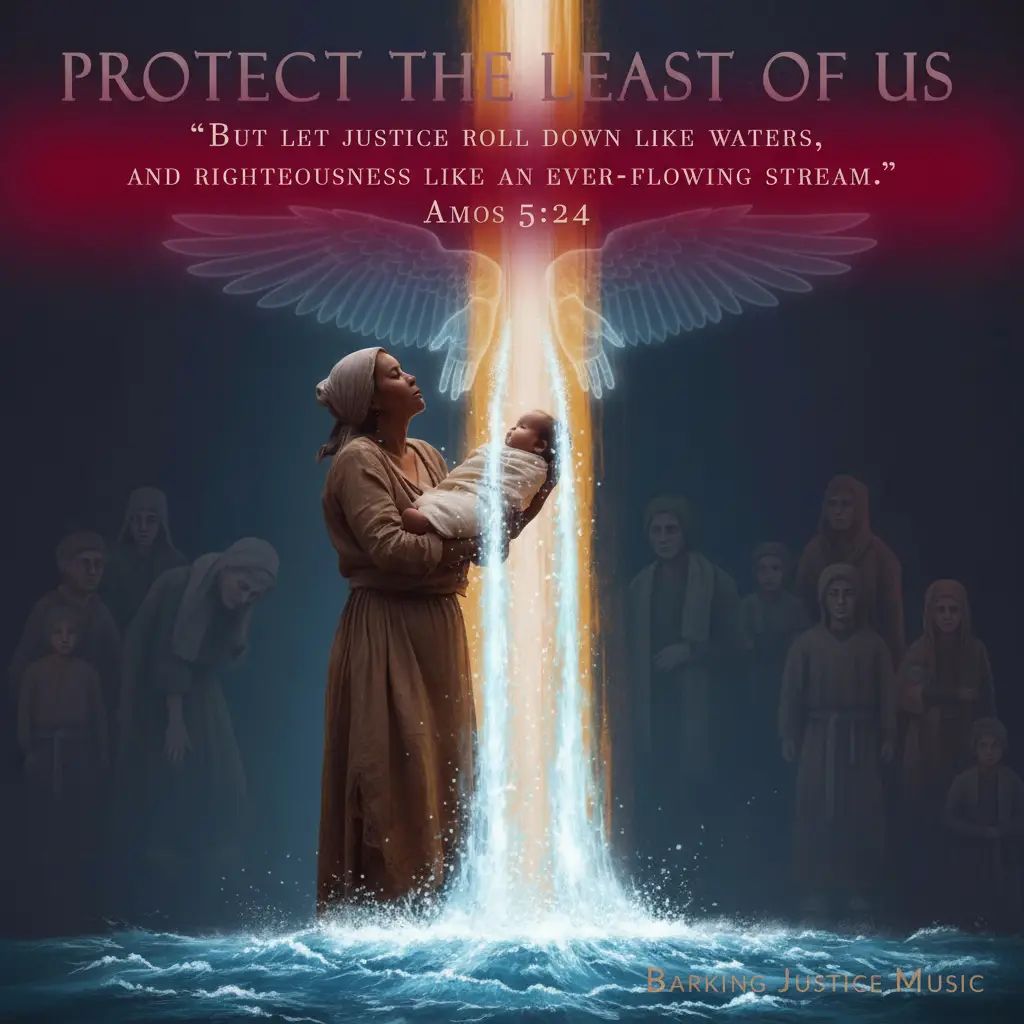
coming soon
Protect The Least of Us
Protect the Least of Us, a social justice radio program confronting poverty, healthcare injustice, disability barriers, and systems that abandon people with the least power.
Public Morality Must Reach Public Policy
THE MORAL-FUSION TRADITION
Protect the Least of Us stands within the American moral-fusion tradition advanced by Rev. Dr. William J. Barber II, Repairers of the Breach, and the Poor People’s Campaign.
That tradition brings poverty, healthcare, labor, voting rights, disability, housing, racial justice, immigrant dignity, and democracy into one moral demand: public policy must lift from the bottom rather than abandon the people with the least power.
Barking Justice Radio carries that work into an independent broadcast form through true stories, civic analysis, and original music written to make the human consequences of policy impossible to ignore.
From the Banner Anthem
The banner song reduces the program’s argument to a question every listener can carry into the next policy debate:
“Does it lift the weary?
Does it heal the scar?
Does it serve the people, whoever they are?
Every law, every promise, every one of us
must protect the least, must protect the least of us.”
That question is the program’s moral instrument. It turns abstract policy into a human test: does a decision protect life, dignity, care, and belonging, or does it shift danger onto the people least able to absorb it?
The anthem connects poverty and economic justice to healthcare, wages, hunger, incarceration, and democratic responsibility. It asks listeners to judge policy not only by what leaders call it, but by what it does after it enters a home, a hospital, a prison, or a human body.
Read the lyrics, meaning, and civic context of “Protect the Least of Us.”
Frequently asked questions
What is Protect the Least of Us?
Protect the Least of Us is a 90-minute social justice radio program from Barking Justice Radio. It combines true stories, public-policy analysis, bilingual passages, and original protest anthems to examine what happens when laws, budgets, prices, institutions, and political decisions reach people with the least power.
What issues does the program cover?
The program connects poverty and economic justice, healthcare justice, disability justice, immigrant dignity, prison healthcare, labor rights, housing insecurity, hunger, elder care, rural medical access, and democratic responsibility.
What does moral fusion mean in this program?
The moral fusion movement rejects the idea that poverty, healthcare, disability, wages, voting rights, housing, immigration, and incarceration are isolated struggles. It brings people together across issue areas, identities, faiths, regions, and political categories around a shared moral demand: public policy must protect human dignity and lift from the bottom.
How is Protect the Least of Us different from Policy Becomes Harm?
Policy Becomes Harm follows a particular government decision through the chain from policy to household consequence. Protect the Least of Us holds the broader moral line. It remains focused on the people with the least power to absorb those consequences and asks what their treatment reveals about the nation itself.
Who does the program hold accountable?
Not the nurses, caregivers, teachers, public servants, advocates, and family members still trying to help inside difficult systems. The program examines institutions and policies that convert human need into profit, delay, exclusion, punishment, or abandonment.
Is Protect the Least of Us affiliated with the Poor People’s Campaign?
Protect the Least of Us is an independent Barking Justice Radio production. It draws intellectual and moral inspiration from the American moral-fusion tradition but does not claim endorsement by or formal affiliation with the Poor People’s Campaign, Repairers of the Breach, Rev. Dr. William J. Barber II, or Yale Divinity School.