
CONSTITUTIONAL LITERACY · RIGHTS · RULE OF LAW
The Constitution Hour:
The U.S. Constitution Explained
The Constitution is not a relic under glass. It is a promise under pressure, and it only lives when the people understand what it protects.
The Constitution Hour explains how power is divided, which rights government must respect, where the original promise failed, and what citizenship requires when those safeguards are weakened.
Segment banner song: The Law Belongs to the People
What the show is
The Constitution Hour offers the U.S. Constitution explained in plain language for people who want to understand what government may do, what it must not do, and what happens when power decides the rules no longer apply.
This is civic literacy radio for an unfinished republic.
The Constitution is often taught as a collection of old articles, amendments, dates, and court decisions. The Constitution Hour treats it differently: as a living framework that divides power, protects the individual, defines citizenship, and places boundaries around those who govern.
The program explains Congress, the presidency, the courts, checks and balances, constitutional amendments, civil liberties, and the rule of law without assuming that listeners have legal training.
But explanation alone is not enough.
The Constitution does not defend itself. Courts do not defend themselves. Elections do not defend themselves. Rights do not defend themselves. The people do.
That is why every episode asks three continuing questions:
What does the Constitution promise? How is that promise being weakened? What is expected of citizens if we still intend to live in a republic rather than beneath a ruler?
The Constitution Hour also tells the truth about the document’s original exclusions. The founding language spoke of liberty while slavery remained protected, women lacked full political citizenship, Native nations were displaced, and millions stood outside the promise of “We the People.”
The program follows the long struggle to widen that promise through abolition, Reconstruction, amendments, voting, protest, organizing, litigation, sacrifice, and constitutional repair.
That history matters because constitutional rights explained honestly must include both the rights written on the page and the people who had to fight to make those rights real.
The Thirteenth Amendment abolished slavery. The Fourteenth established birthright citizenship, due process, and equal protection. The Fifteenth prohibited racial discrimination in voting. Those amendments did not merely revise the original document. They redirected its moral meaning toward a more complete definition of citizenship.
That work remains unfinished.
Voting rights remain central because the ballot is how citizens enter the governing system and answer those who exercise power. A person may live under the law, pay taxes under the law, be policed under the law, and be punished under the law. If that person cannot help shape the law, self-government has become control.
No crown. No king. No throne.
The ballot is a door.
Due process is not weakness.
The law belongs to the people.
The segment’s banner anthem, “The Law Belongs to the People,” rejects the idea that law belongs to presidents, judges, parties, wealth, or officeholders. It belongs to the public, and it earns legitimacy only when it protects the powerless as faithfully as it protects the powerful.
The Constitution Hour is foundational. It teaches the framework, rights, limits, and duties of the republic.

Show details
Who it’s for
Citizens, students, educators, voters, veterans, families, and general-interest listeners who want the Constitution explained without legal jargon or partisan theater.
When it airs
Tuesday 6 AM · Thursday 10 AM · Saturday 2 PM, streaming live.
Format
60 minutes. Plain-English constitutional analysis paired with original protest music.
Coming attraction
Rights Under Fire: A constitutional lens on a specific right currently facing legal or political pressure.
Songs That Give the Constitution a Living Voice
These original Barking Justice Music anthems translate constitutional structure, rights, and civic responsibility into language listeners can carry beyond the broadcast.
All tracks are original productions from Barking Justice Music, produced for Barking Justice Radio.
Merch preview
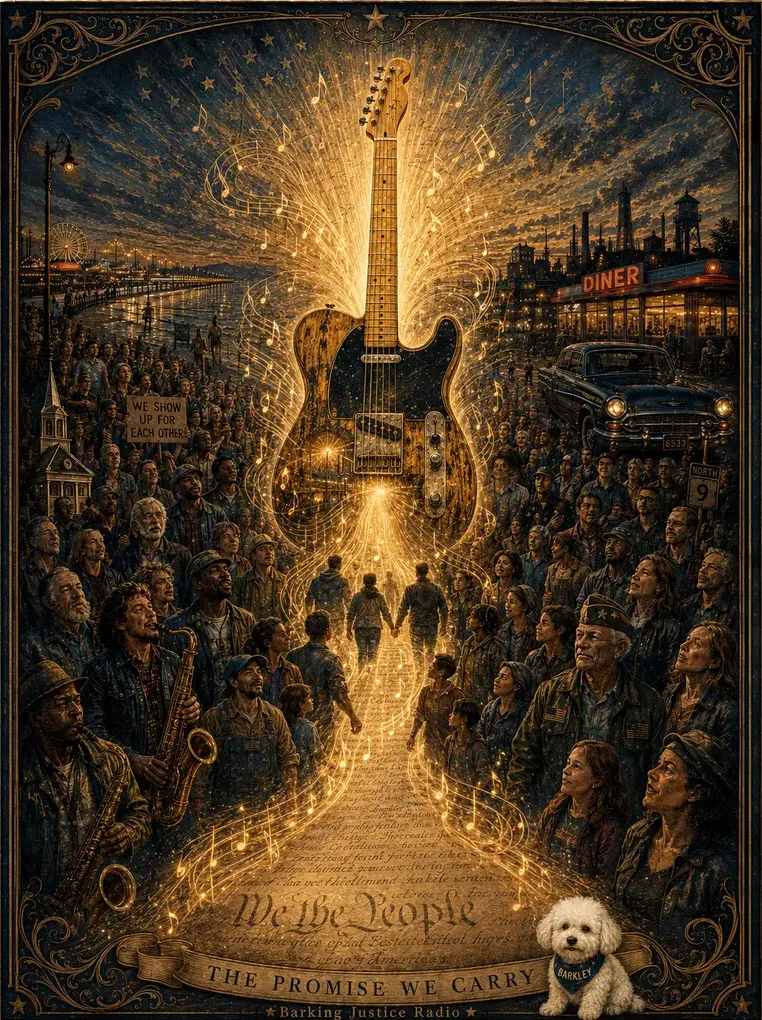
Merch Preview
The Promise We Carry
Artwork — soon available on our Merch page.
Related excerpt
From the banner anthem: “The Law Belongs to the People”
The law does not belong to a president, a court, a party, or a wealthy few. It belongs to the people whose rights it promises to protect. “The Law Belongs to the People” turns constitutional structure into a civic demand: power is borrowed, office is a trust, and no public official stands above the law.
“The law belongs to the people, not the palace, not the throne. Not the fist around the gavel, not the king who stands alone.”
The anthem reflects the central argument of The Constitution Hour: a republic is not preserved by ceremony. It is preserved when citizens understand the rules, defend the rights of others, and refuse to let power convert public office into ownership.
Frequently asked questions
What is The Constitution Hour?
The Constitution Hour is a 60-minute civic literacy radio program offering the U.S. Constitution explained in plain language through narration, historical context, and original protest music.
It explores constitutional structure, individual rights, limits on government power, the original exclusions in the founding document, and the responsibilities citizens carry in keeping the republic alive.
What does the U.S. Constitution do?
The Constitution establishes the structure of the federal government, assigns powers to its branches, limits how government may exercise those powers, and provides the framework through which amendments and constitutional rights operate.
It is both a grant of power and a boundary around power.
What is separation of powers?
Separation of powers divides federal authority among Congress, the president, and the courts. Each branch has its own responsibilities, and each is supposed to prevent the others from accumulating unchecked power.
The purpose is not efficiency. It is protection against concentrated rule.
The Library of Congress Constitution Annotated describes separation of powers as a central doctrine derived from the Constitution’s text and structure.
What constitutional rights does the program explain?
The program addresses freedom of speech, religion, press, assembly, protection from unreasonable searches, due process, equal protection, birthright citizenship, voting rights, and the right to fair legal proceedings.
The exact subject changes by episode, but the central question remains: what line was government forbidden to cross, and what happens when it crosses it?
What is Rights Under Fire?
Rights Under Fire is the current-events companion to The Constitution Hour. Each installment focuses on one constitutional right facing a specific legal or political challenge, such as speech, surveillance, due process, equal protection, or birthright citizenship.
The Constitution Hour teaches the foundation. Rights Under Fire examines the pressure being applied to it.