
Spanish-Language Lane · Barking Justice Radio
La Línea: Civic Radio in Spanish from Puerto Rico
A named Spanish-language lane connecting Latino civic audiences across Puerto Rico, the Cuban-American community, Mexican-American veterans, and Central American immigrant families. Not a translation project — a distinct editorial voice rooted in the same civic mission. Broadcasting in Spanish from Puerto Rico gives La Línea geographic and cultural authority no mainland competitor can replicate.
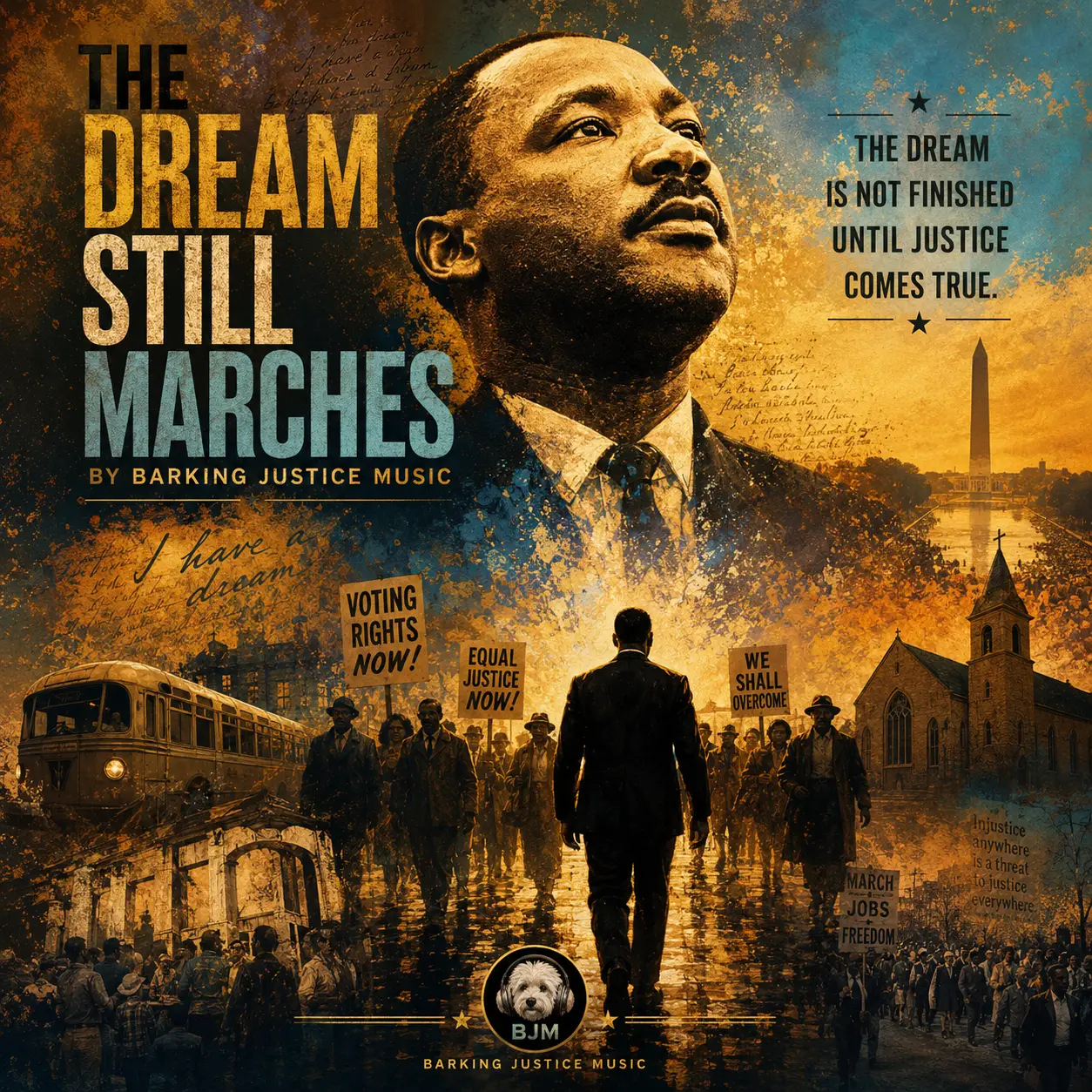
Segment banner song: The Dream Still Marches
What La Línea is
La Línea is a new programming lane at Barking Justice Radio, bringing the station’s civic reporting and protest music to Spanish-speaking audiences who don’t currently have a comparable civic outlet covering these issues in their language.
The mission is the same one driving every other block on the station: civic urgency, named consequences, and music that carries the argument. La Línea’s job is to make sure that same mission reaches communities it wouldn’t otherwise reach — Boricua veterans, Cuban-American veterans, Mexican-American Vietnam veterans, Central American service members, Latino immigrant families, and Spanish-speaking civic listeners across Puerto Rico, Texas, California, and beyond — researched for the specific issues each of those communities is living through, not treated as one interchangeable audience.
La Línea is being built as four blocks, each adapting an existing Barking Justice Radio format for a Spanish-speaking audience and researched for the history and civic context that community needs covered. Details below.
Every episode brings that history forward through original protest music, remembrance, and moral testimony, showing how earlier struggles shape today’s battles. Freedom was never handed down. It was demanded, defended, sung, and marched for, and this segment treats that demand as unfinished business rather than a closed chapter. The hour listens back so listeners can look forward, asking who gets protected, who gets believed, who gets counted, and who gets to breathe freely inside the promise of America.
The four blocks
Marching Still en Español
The lane’s anchor and the station’s most strategically important Spanish block. Full Spanish production with a distinct musical palette: corridos de guerra, Puerto Rican and Cuban veteran memory, Latin protest music. Reaches Boricua veterans, Cuban-American veterans, Mexican-American Vietnam veterans, and Central American service members — communities with no comparable civic radio programming.
La Memoria Viva
The Spanish Civil Rights Memory Hour. Focuses on Afro-Latino history, Puerto Rican labor and independence movements, Cuban civil rights, the Chicano Movement, Central American immigrant struggles, and the continuing fight for Latino civic inclusion. Treats this history as its own arc, not a subset of the American story.
Ella Cargó la República
The Spanish adaptation of She Carried the Republic, built for a Latin American civic context. Centers the women who carried Latino communities through migration, labor, political exclusion, and cultural erasure: Puerto Rican organizers, Cuban exiles who rebuilt civic life, Chicana labor leaders, undocumented mothers who built institutions without recognition, and Indigenous women protecting land and water.
El Costo Humano
The Human Cost variant in Spanish, and the lane’s most urgent block. Immigration policy, deportation, family separation, Medicaid denial in Spanish-speaking communities, hospital closures in Latino neighborhoods, farmworker injury without compensation, and the compounding harm of policies that treat Latino communities as acceptable collateral damage.
Show details
Who it’s for
Latino civic listeners, Afro-Latino communities, educators, immigrants and immigrant families.
When it airs
In Development
Format
30- 60 minutes. Narrated history and moral testimony paired with original protest music.
Coming attraction
Freedom was never handed down — it was demanded, defended, sung, and marched for.
Representative anthems
Music carries the argument as much as the narration does. These are the tracks that make up La Linea rotation:
All tracks are original productions from Barking Justice Music, produced for Barking Justice Radio.
Merch preview
Merch Preview
La Línea
Artwork — soon available on our Merch page.
Related excerpt
From the segment banner song: The Dream Still Marches
This anthem opens the segment by remembering Dr. Martin Luther King Jr. not as a statue or a holiday, but as a witness, a preacher, and a strategist who understood that love without justice becomes silence. It treats the dream as a demand still awaiting an answer.
“The dream still marches. It walks through the flame. It carries the wounded. It calls every name.”
Read the full lyrics and civic context in The Firing Line’s companion piece on civil rights memory.
Frequently asked questions
What is La Línea on Barking Justice Radio?
A Spanish-language programming lane connecting Latino civic audiences across Puerto Rico, the Cuban-American community, Mexican-American veterans, and Central American immigrant families to the same civic mission driving the rest of Barking Justice Radio.
What should listeners expect as La Línea blocks launch?
Each block launches on its own, researched for the specific community and history it covers, rather than one lane rolling out all at once. The focus is the same civic urgency running through the rest of the station’s programming, brought to a Spanish-speaking audience.
Why does La Línea build four separate blocks instead of one general Spanish-language show?
Because a single Spanish-language show would flatten distinct audiences and histories into one generic lane. Each block is built for a specific community and civic history — Latino veterans, Afro-Latino and Chicano civil rights history, Latina civic leadership, and the human cost of policy in Spanish-speaking communities — rather than treating “Spanish-language” as one interchangeable audience.
Does the show cover more than the well-known civil rights leaders?
Yes. Alongside figures like Dr. Martin Luther King Jr. and John Lewis, the hour foregrounds the organizers usually pushed to the edge of the photograph — Ella Baker, Septima Clark, Diane Nash, Jo Ann Robinson, Georgia Gilmore, Daisy Bates, Claudette Colvin, Rosa Parks, and Fannie Lou Hamer — as the architects who built the movement’s infrastructure, not footnotes to it.
How does The Civil Rights Memory Hour connect this history to today's politics?
Each anthem is paired with commentary that traces a direct line from the historical struggle to a present-day parallel, whether that’s voting rights fights, book bans, gerrymandering, or protest suppression. The segment’s position is that progress is a practice that can be weakened or reversed, not a permanent possession, and that recognizing old patterns in new language is a form of civic protection.