
WOMEN · MEMORY · CIVIC COURAGE
She Carried the Republic:
A Women’s History Radio Show
Women did not stand at the margins of American history. They built the rooms, opened the doors, carried the work, and forced the country closer to its promise.
Segment banner song: She Took the Mantle: Moral Courage
What the show is
She Carried the Republic is a corrective women’s history radio show about the organizers, workers, teachers, judges, lawmakers, caregivers, and resisters who carried American democracy forward when the country did not fully carry them.
This is not sentimental history. It is not decorative recognition, a calendar-month tribute, or a collection of famous firsts.
It is a correction.
The segment’s premise is simple: America was not shaped by presidents, generals, founders, and judges alone. Women carried the republic when the republic did not fully carry them, and the work did not end. It changed hands, and it is still being handed forward.
American history is often told through presidents, generals, founders, industrialists, and judges. But movements were also built by the woman who called the meeting, taught the class, kept the list, organized the boycott, challenged the law, carried the testimony, fed the family, protected the vote, and stayed after everyone else went home.
These are the women who shaped American history, often without receiving the authority, protection, recognition, or public memory their work deserved.
Each episode moves in acts. The journey may begin in a schoolroom, a field, a kitchen, a bus seat, or a church basement. It may continue through a voting line, a union hall, Congress, a courtroom, or the federal bench. Every setting reveals the same truth: democracy does not live only in speeches and marble buildings. It lives wherever ordinary people learn how to use their rights.
The women in this program did more than enter history. They made history usable.
Claudette Colvin and Rosa Parks turned the body into testimony against a law built on humiliation. Ella Baker taught that movements grow when ordinary people learn to lead themselves. Fannie Lou Hamer forced the country to hear what voting rights looked like when the courthouse door was guarded by violence and fear.
Shirley Chisholm entered political power without allowing gratitude to make her quiet. Pauli Murray exposed the architecture linking racial and gender discrimination. Ruth Bader Ginsburg carried that reasoning into courtrooms where the law had to confront its own assumptions. Women on the federal bench changed who was trusted to interpret justice, even when representation did not guarantee victory.
Dolores Huerta showed that labor rights, family dignity, food, wages, and democratic power belong in the same moral frame. Tarana Burke, Stacey Abrams, Ai-Jen Poo, Sherrilyn Ifill, and other modern organizers remind us that the relay did not end. It changed hands.
Sometimes it is a folding chair in a meeting room.
Sometimes it is a teacher staying after class.
Sometimes it is a ride to the polling place, a witness on the stand, a legal brief, a clipboard, a kitchen light, a caregiver who keeps showing up, or a woman telling power that the people it ignored still have names.
The program also examines women in civic leadership without reducing leadership to officeholding. Leadership may take place in Congress or on the Supreme Court, but it also grows in classrooms, fields, unions, tribal communities, homes, civil rights organizations, and local campaigns.
Every act is answered by music.
The narration establishes the life, the historical pressure, and the civic meaning. Then an original Barking Justice anthem gives that meaning an emotional memory. This is women’s history through music, not as background decoration but as a second form of testimony.
The songs honor refusal, organizing, voting, legal argument, labor, care, survival, and the transfer of responsibility. They are original women’s history songs written to help listeners remember not only what each woman accomplished, but what she understood about power.
The segment’s banner anthem, “She Took the Mantle,” begins far from the marble halls of government. It begins at the kitchen table, beside medicine, unpaid bills, tired workers, teachers, caregivers, voters, and children waiting for the country’s promises to become real.
Its argument is that compassion is not weakness. Care is not separate from power. A country has no conscience until moral concern reaches the places where people actually live.
That is why the music qualifies as women’s rights music, but the program’s subject is larger than rights alone. It is also about labor, public memory, democratic participation, representation, community survival, and the civic structures women built when formal power excluded them.
She Carried the Republic does not remember women to make the past more beautiful. It remembers them because the present is asking what we will do with the work they placed in our hands.
The relay continues.
For this stretch of the road, we carry it.

Show details
Who it’s for
Listeners who want women’s history told as American history, including educators, students, civil rights listeners, families, civic learners, movement historians, and people who want to understand how democratic change is actually built.
When it airs
Monday 12 PM · Wednesday 12 PM · Friday 12 PM · Sunday 12 PM, streaming live.
Format
Companion segment
Original Women’s History Songs
Music answers the narration in every act. These original anthems turn biography into public memory, helping listeners feel what each woman carried, challenged, changed, and handed forward.
All tracks are original productions from Barking Justice Music, produced for Barking Justice Radio.
She Carried the Republic
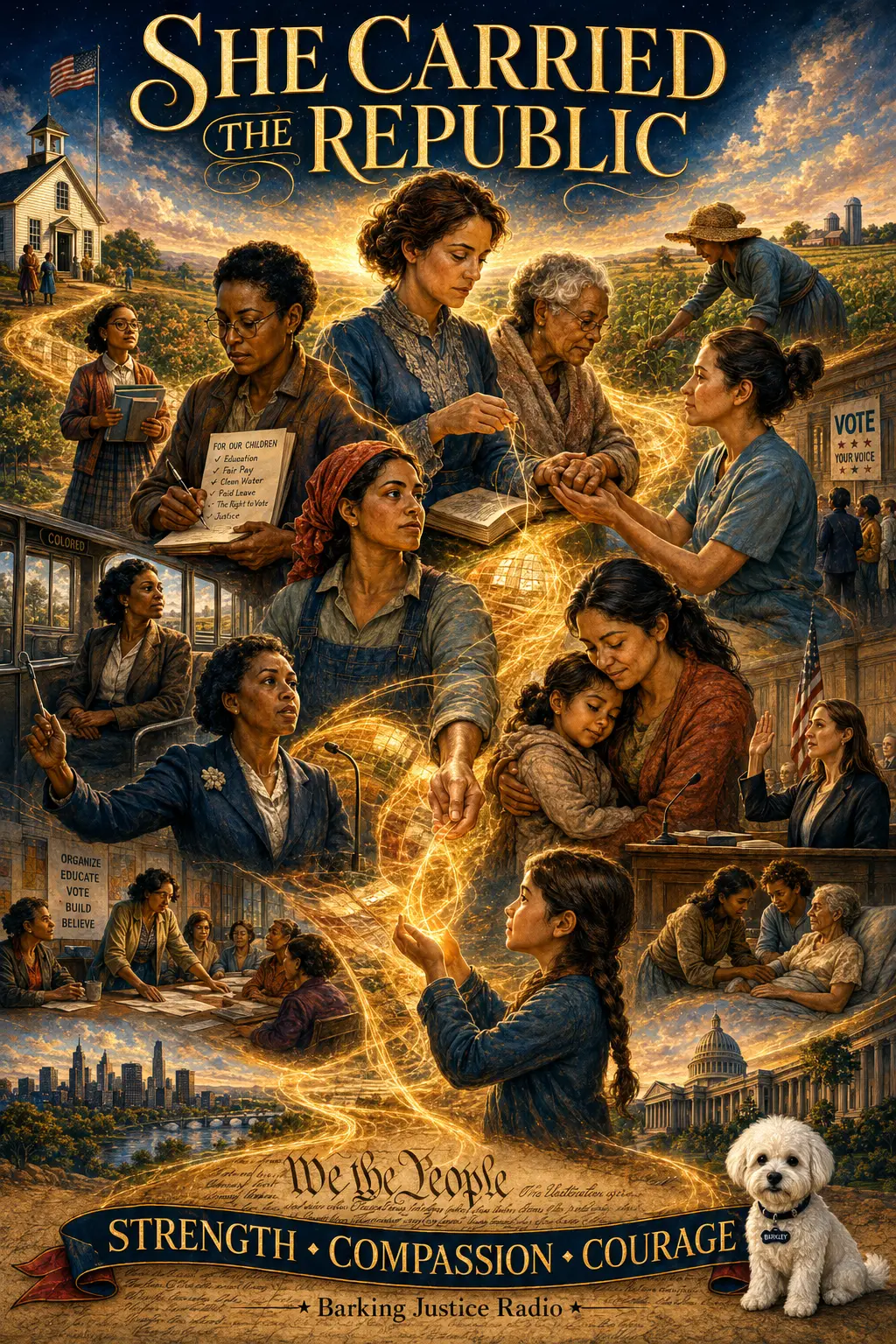
Merch Preview
She carried the republic
STRENGTH . COMPASSION . COURAGE
Related excerpt
From the banner anthem: “She Took the Mantle”
Some histories begin in a courtroom or at a podium. “She Took the Mantle” begins at the kitchen table, where medicine is divided, care work is hidden, labor is exhausted, and public policy becomes daily life.
The anthem honors women who brought moral power into ordinary places: the teacher, organizer, field worker, mother, survivor, caregiver, voter, lawyer, and witness. It refuses the idea that compassion is separate from leadership or that care is a lesser form of civic strength.
“She took the mantle in her hands.
She brought the mercy home.”
The song carries the central argument of She Carried the Republic: power becomes human when it recognizes the people whose work, pain, courage, and dignity have too often remained outside the official story.
Frequently asked questions
What is She Carried the Republic?
She Carried the Republic is a 60-minute women’s history radio show that tells American history through the women who organized movements, taught citizenship, challenged unjust laws, protected voting rights, led workers, entered public office, changed legal thinking, and carried democratic work forward.
Each act pairs spoken historical storytelling with an original anthem written around the woman or movement being remembered.
Why is the program described as corrective history?
The program begins from the premise that women were not side characters in American history. They built institutions, sustained movements, organized communities, changed law, carried families, and made democratic participation possible.
Corrective history restores that work to the center of the national story rather than adding women as an afterthought.
Which women are featured in She Carried the Republic?
The program features figures including Claudette Colvin, Rosa Parks, Ella Baker, Fannie Lou Hamer, Shirley Chisholm, Pauli Murray, Ruth Bader Ginsburg, Sandra Day O’Connor, Sonia Sotomayor, Ketanji Brown Jackson, Dolores Huerta, Tarana Burke, Stacey Abrams, Ai-Jen Poo, and Sherrilyn Ifill.
The series can continue expanding to women in labor, law, education, tribal leadership, public health, community organizing, journalism, science, military service, and other areas of civic life.
Is She Carried the Republic only about famous women?
No. The program also honors the organizing methods and hidden labor behind public change: the person who called the meeting, taught the class, kept the records, cared for the family, registered voters, brought food, found transportation, gathered testimony, or made sure the movement continued.
The premise is that history often remembers the face at the microphone while forgetting the hands that built the room.
How does the program explore women in civic leadership?
The program defines civic leadership broadly. It includes elected officials and judges, but also teachers, labor organizers, voting-rights advocates, lawyers, caregivers, movement builders, and community leaders.
Leadership is measured not only by who held office, but by who made rights usable and helped ordinary people exercise power.
What role does music play in the program?
Every historical act is paired with an original anthem. The narration explains the life and historical context; the music carries the emotional and moral meaning.
This approach presents women’s history through music, helping listeners remember the stakes, courage, and unfinished lesson rather than only a sequence of dates.
Are the songs original?
Yes. The program uses original women’s history songs created by Barking Justice Music for the women and movements featured in the broadcast.
The songs address organizing, civil rights, voting, labor, equal citizenship, caregiving, legal change, representation, and the transfer of civic responsibility across generations.
Does the program only cover the past?
No. Each episode follows the history into the present.
The modern relay includes women working in survivor advocacy, voting rights, care work, labor, legal accountability, education, public service, and civic organizing. The program’s premise is that the work did not end. It changed hands.
What does “women carried the republic” mean?
It means women often sustained and expanded democratic life even when they were denied full access to political, economic, and legal power.
They taught citizenship, organized voters, challenged discriminatory laws, built movements, cared for communities, and widened the meaning of equality while the country failed to protect or recognize them fully.
How is this different from a standard history program?
She Carried the Republic is not structured as a lecture or a list of accomplishments. It uses close, reverent narration, human detail, original music, and a continuing civic question:
What did she carry, what did she change, and what has now been handed to us?